
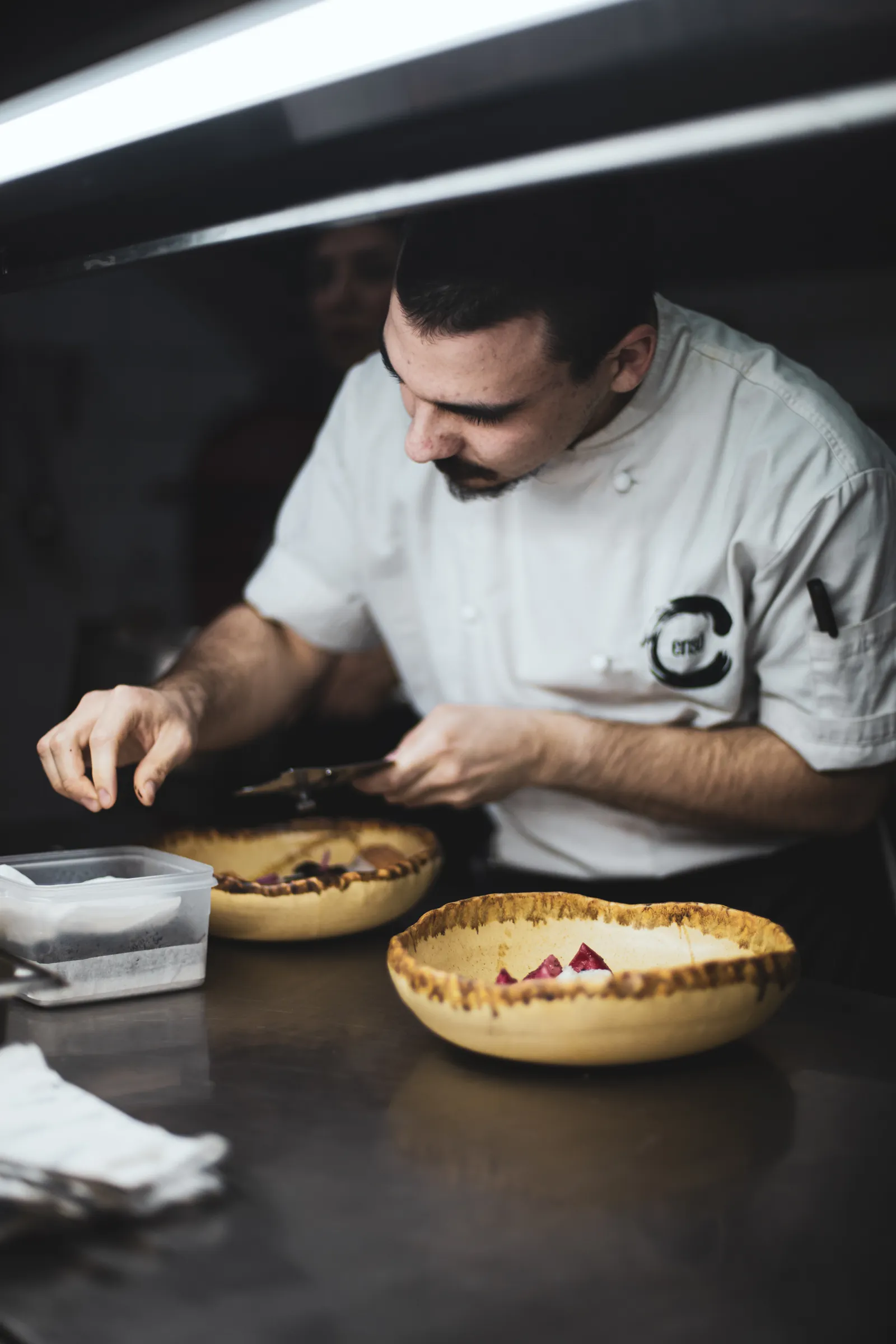
What’s harder: creating a great dish or making it just as good for the fiftieth time?
A single great dish represents a moment of culinary expression, but a chef’s true skill is reflected in the standards they maintain over time. Routine can dull awareness, undermine focus and compromise precision. That’s why consistently reproducing the same level of quality is much harder.
What part of a sous chef’s job do guests never see, even though it takes up most of your time and energy?
There shouldn’t be any part of a chef’s work that guests don’t experience in some way. From repetitive tasks and the careful preparation and shaping of ingredients to precise, beautiful plating, guests should be able to appreciate every detail. Everything a chef does is reflected in the plate placed before the guest. Nothing is hidden.
How much room is there for ego in a serious kitchen?
Arrogance towards your work or your colleagues has no place in a serious kitchen. It’s important to be humble but proud, modest yet confident, and to have a strong sense of who you are. That’s the only way a young chef can continue to grow and develop their skills.
If you could permanently eliminate one thing from modern fine dining, foams, tweezers, edible flowers, overly complicated dish descriptions, or something else, what would it be?
Complex descriptions and tweezers both have their place in the kitchen and in hospitality. If a dish is complex, its description can’t always be simple. If a dish requires obsessive precision, tweezers and pipettes are exactly the right tools.
But we should also be honest with ourselves. Not every dish needs a pretentious name. There’s no reason to distance ourselves from honest, simple food. Instead, we should celebrate it.
What do you eat after spending ten hours in a fine dining kitchen? Is another “perfectly balanced plate” the last thing you want?
I think I eat a relatively healthy and varied diet. I pay attention to what I eat, where I buy my ingredients and how I prepare them.
Despite my best efforts to eat healthily, after a long working day I absolutely love indulging in snacks, the saltier and crunchier, the better. Smoki will always be my favourite.
Who is harder to please: Nedeljko, the guests, or yourself?
I work directly with Nedeljko, so we’re constantly communicating and collaborating. I always have a clear understanding of his ideas.
Guests are a little more challenging because they’re unpredictable. But through years of working, learning and visiting restaurants as a guest myself, I’ve developed an intuition that continues to improve.
What’s one thing you learned at culinary school that you had to completely unlearn when you entered a professional kitchen?
At school, there was always a certain level of strict formality, almost a military approach to work. But once I started working in professional kitchens, I realised that people were actually much more relaxed.
Was there a particular moment when you first thought, “Okay, I really want to be a chef”?
There wasn’t one defining moment when I decided to become a chef. Instead, throughout my education and my first jobs, I gradually became more and more certain that this was the profession for me.
What matters more to you today, creating something perfect or creating something that is truly yours?
I’m not someone who believes in perfection. Every idea evolves and takes shape; it never remains exactly the same.
For something to be authentically mine, it has to evolve with me. Above all, I try to do my work properly, but it’s also important to leave my personal mark on what I create. And I can’t do that unless I believe in the quality of my own work.
How difficult is it to find your own style when you’re working alongside people who have far more experience than you?
I actually think it’s impossible to find your own style without working alongside people who have extensive experience.
Like any artist or craftsman, a chef must first master the fundamentals before using their medium as a form of expression. You can’t develop a personal style without a solid foundation and experience.
What do Nedeljko and Marko know through experience that no culinary school could ever teach you?
Through their many years of experience, Nedeljko and Marko have developed an incredible intuition and an ability to accurately assess both kitchen operations and guests.
It’s almost as if they know exactly what each guest is going to order, how much of each ingredient needs to be prepared, and what flavours guests will want to experience on the next menu.
Culinary school can teach you technical skills, but intuition comes with experience. I’ve noticed this quality in both of them, and I’m gradually learning to develop it myself.
Is there something your generation brings to the kitchen that they perhaps didn’t have when they were starting out?
I believe every generation has its own strengths, including mine.
Younger generations have direct access to the global culinary scene. In the past, people were largely limited to what was immediately around them. Today, our access to information is almost limitless.
Techniques, inspiration and education are all at our fingertips, and I believe we’ll use these opportunities to develop and improve our skills.
Do you cook better when there’s good music playing in the kitchen? And what should absolutely never be played during service?
I think metal music and the fast-paced environment of a professional kitchen were made for each other.
Metal is the perfect music for cooking. It fits the energy and atmosphere of the job incredibly well.
I can’t stand anything slow and monotonous. It makes me sleepy and, even worse, completely kills the vibe.
If you had to describe ENSO as a musical genre, what would it be?
I’m very aware that jazz culture is woven into the identity of ENSO, and I think that’s something you can genuinely feel here.
The spirit and philosophy of jazz are very much alive in this restaurant.
As a young chef, what scares you more: making mistakes or eventually falling into a routine?
Of course, I don’t like making mistakes. But I’ve stopped being afraid of them because I’ve realised they’re inevitable.
I still do my best not to waste an ingredient or send out a dish that isn’t right.
I’m not afraid of routine because I see it as a state of mind rather than an external circumstance. It’s entirely up to me whether I experience my work as a repetitive obligation or as something enjoyable.
If we interviewed you again in ten years, what would you like to be able to tell us you’ve achieved?
Alongside my personal achievements, I’d love to have gained as much knowledge as the people who taught me or even more.
Most importantly, I’d like to share that knowledge generously with the generations that come after me. I’d love to be able to say that I’ve taught someone else how to cook.