
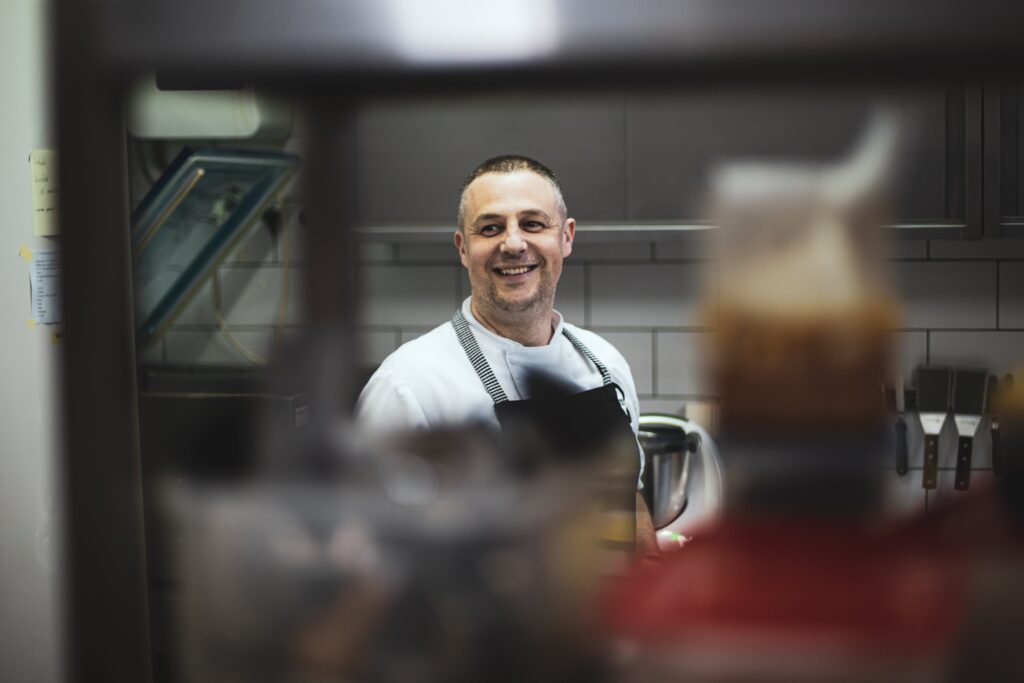
A lot can change in a kitchen over ten years – techniques, trends, ingredients and guests’ expectations. But perhaps what changes most is the way a chef thinks about food.
Nedeljko Jerković has led the kitchen at ENSO since the restaurant first opened its doors. Over the years, his approach has become more precise, more focused and, as he puts it, less concerned with impressing at all costs. Today, he is more interested in clarity of flavour than complexity for its own sake, in great ingredients rather than trends, and in the guest’s experience rather than displaying technique.
As ENSO prepares to introduce its new autumn menu, we sat down with Nedeljko to talk about how Serbia’s dining scene has changed, where he finds inspiration today, why he thinks truffles are overrated, and what he would do differently if he were opening ENSO for the first time now.
1. How many times does a dish change – in appearance or recipe – before you finally say, “Now it’s ready for the guest”?
There is no rule. Sometimes a dish is ready after two or three trials, while others take much longer to develop. Most often, we first find the flavour we want to achieve and then look for the best way to present it on the plate.
2. How much does the Serbian dining audience surprise you today? Have guests become more adventurous when it comes to new flavours, or do they still prefer what feels familiar?
They pleasantly surprise me. I think guests are much more open-minded today than they were ten years ago. They travel more, they are interested in different cuisines, and they are willing to try things they have never eaten before. Of course, we all love flavours that remind us of childhood and things we know, but I see a growing number of people coming to us specifically because they want to discover something new.
3. What have you deliberately removed from the plate this year? Not an ingredient, but a philosophy.
The need to impress at all costs. In the past, I sometimes wanted to show how complicated a technique was or how unusual an idea could be. Today, it is more important to me that a dish is clear, delicious and makes sense. A guest doesn’t come to see how much effort went into a dish – they come to enjoy the result.
4. What inspires you more today: the market or Instagram?
Definitely the market. Instagram can be interesting for following trends and seeing what colleagues around the world are doing, but real inspiration comes when I see a beautiful seasonal ingredient or discover something I wasn’t expecting.
5. When you taste something exceptional at a restaurant abroad, does your competitive side kick in, or does it inspire you more than it puts pressure on you?
It inspires me more. Of course, I think about how I would like us to reach that level as well, but above all, I feel respect for the work behind a dish like that.
6. When you say “autumn on a plate,” what is the first image that comes to mind?
Wild mushrooms, root vegetables, chestnuts, pumpkin and the smell of earth after the rain. For me, autumn is about warmer, deeper and more complex flavours – flavours that create a sense of comfort while still leaving room for elegance on the plate.
7. Will this year’s autumn menu be more adventurous than the previous one, or will you rely more on tried-and-tested flavours?
We will try to find a balance between the two. I love exploring new combinations, but never at the expense of flavour. If something is bold, it also has to be delicious. That is the one rule I always follow.
8. Have we become more adventurous as a dining audience, or do we simply travel more?
I think one has led to the other. Travel has broadened people’s horizons, but being adventurous ultimately comes from curiosity. Today, guests are much less likely to ask what the safest option is and much more likely to want to try something they have never tasted before.
9. What is more difficult today – creating an exceptional dish or convincing a guest to try it?
Creating an exceptional dish is always the harder part. If a dish is genuinely well thought out and presented honestly, the guest will give it a chance. People are far more open-minded than we often assume.
10. What is the greatest enemy of culinary creativity in Serbia: price, habits or fear of the unknown?
I would say habits. Price is certainly a challenge, but habits are much harder to change. Once they do change, people are willing to spend money on an experience they consider worthwhile.
11. Is there an ingredient you think is completely overrated?
Truffles. I like them and I use them, but I think they are often used as a shortcut to luxury. A good product doesn’t automatically become a better dish simply because you grate some truffle over it.
12. What is the worst culinary rule people keep repeating?
That more ingredients make a better dish. Sometimes three or four ingredients are enough to say everything that needs to be said. Removing what is unnecessary is often harder than adding something new.
13. When you cook at home, what do you never make?
Anything that reminds me of work. At home, I like simple food that I can prepare without having to think too much about it.
14. What would you be least likely to order at a restaurant?
Something I could easily make at home. When I go to a restaurant, I want to experience someone else’s idea.
15. If you were opening ENSO for the first time today, would the menu look the same as it did ten years ago?
Definitely not. I have much more experience today, I understand ingredients differently, and I would probably be even bolder with some of my decisions.
16. What would you like a guest to think after finishing the final bite of the autumn tasting menu?
I would like them to feel that they have spent an evening they will remember. Not necessarily because of one particular dish, but because of the experience as a whole. If they leave wanting to come back and see what we create next, then we have done our job well.
Nedeljko Jerković
Head Chef at Enso